Sunday, February 28, 2010

What We Can Learn From Market History


Historical precedent is an extremely fallible guide to future market behavior. In fact, the only investment strategy worse than relying on history is one that ignores history.

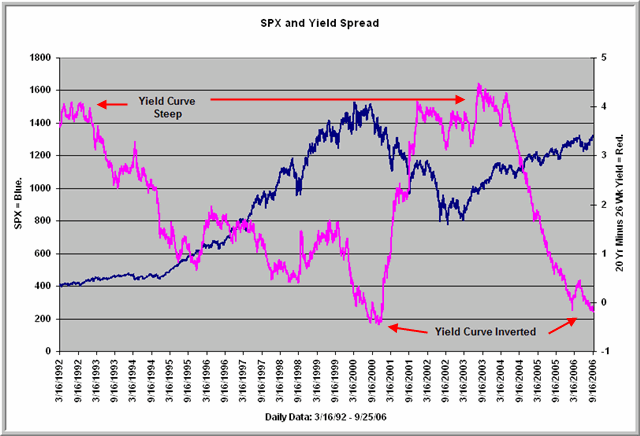
After hearing yet one more trader wax optimistic about stocks rallying when the Fed cuts interest rates, I put together the above chart. What we see is the difference in rates between the 20 year bond and the 26 week bill (red line) vs. the S&P 500 Index.

Notice that at the market top in 2000, we had an inverted yield curve. The bills returned a higher interest rate than the bonds. A similar inversion occurs as I write. What happened when the Fed began aggressively cutting rates, sending the bill yields lower (and the yield spread higher)? Observe how the market tanked all during the initial period of easing.

Is this a universal pattern? No. Short rates climbed steadily in 1994 and the stocks underwent a mild but extended correction. Once the Fed eased rates early in 1995, we began a significant rally in stocks.

What is more important than absolute rates, perhaps, is how fixed income competes with equities for capital. At market tops, we've tended to see the spread between fixed income yields and equity yields well above their moving averages. At market bottoms, we've generally seen the reverse. Thus far, fixed rates, especially on the short end of the curve, compete quite nicely with equity yields. It's when fixed rates become non-competitive on a relative basis that stocks tend to attract interest.

Oh yes; one more historical precedent. Friday was a day in which a large number of stocks displayed significant downside momentum, with my Supply measure (an index of the number of issues closing below their short- and intermediate-term volatility envelopes) exceeding 100. Monday, however, showed significant upside momentum, with the Demand measure exceeding 100.

We've only had 10 occasions since 2003 when we've flipped from strong negative to strong positive momentum in a single session. Four days later, SPY was up by an average .58% (7 up, 3 down)--much stronger than the market's average four-day gain of .17% (522 up, 408 down). Five of the last seven of those occasions during 2005 and 2006 have been profitable four days later.

History doesn't tell us everything, but it's very difficult to find market professionals who have sustained long-term success who don't bring a historical perspective to the table.

The Most Important Psychological Skill for Traders - Part One

A holiday weekend is a good time to review trading journals, pick apart your results, and engage in self-assessment.

If your results are not what you hoped for, an important question to ask yourself is, "Why?".

There are three basic reasons why traders don't succeed:

1) They are trading a market and time frame that lacks opportunity;
2) They are trading a method that does not possess an objective edge in the marketplace;
3) They have a promising market, time frame, and method, but are not executing it properly.

Of these reasons, #3 is the most frustrating for traders. They feel as though they have the tools to succeed, but they themselves get in the way of their own success. Many times this is because emotional factors interfere with sound decision-making.

My recent post on techniques for dealing with emotional disruptions of trading offered a number of links to articles on cognitive, behavioral, and solution-focused methods for gaining self-control. Many more articles on trading psychology are available on my personal site, and a much more detailed explanation of the relationship between psychology and trading can be found in my book. It was because interest was so high in learning self-help methods for dealing with emotional disruptions of trading that I included step-by-step self-help manuals as the last two chapters of my latest book.

My hope is that these resources will help traders become their own mentors.

After my recent post, I received several emails asking a similar question: "What is the best technique I can use for getting myself in control?"

Most psychological disruptions of trading involve either under-control or over-control: traders either become impulsive and lose discipline when frustrated (resulting in overtrading), or they become anxious and negative (and miss out on opportunity).

The key to understanding these problems, as I stress in my book, is to recognize that they are generally state-dependent. They do not occur at all times, under all conditions. Rather, they are triggered by particular events and associated emotional states. The trader who is frustrated or depressed trades differently from the trader who is in a normal, non-aroused emotional state. This is because of brain physiology: we activate different brain regions and functions under conditions of arousal vs. conditions of calm concentration.

For this reason, the most important psychological skill for traders is simply the ability to control your body's level of arousal. It is near-impossible to maintain a collected frame of mind when your body is racing in flight-or-fight response patterns or withdrawing in the face of defeat. If you can control the body, you are much better positioned to achieve cognitive and emotional control.

Three steps can help you gain rapid control if you practice them frequently:

1) Stop whatever you are doing and take a break;

2) Sit comfortably and focus your attention on something neutral. As I mention in my book, a sound and light machine is ideal for this: you simply focus on the patterns of light and eliminate (as much as possible) stray thoughts. Biofeedback games can also be effective in focusing your attention;

3) Once you have your attention fixed, regulate your breathing by taking longer, deeper, and slower breaths. The slowing and deepening of the rate of your breathing will help slow your heart rate, lower your muscle tension, and reduce other biofeedback indicators of stress.

In the beginning, you may need to do this exercise for 10-15 minutes at a time a couple of times per day. As you become more skilled, you'll find that it takes less and less time to get yourself focused and calm. Eventually, just focusing your mind and taking a few deep breaths will get the job done. But it takes steady, consistent practice.

The exercise interrupts negative patterns of thought by controlling your concentration. It also slows your body down, which in turn helps you slow down racing thoughts. Because so many negative behavior patterns are triggered by states of frustration, heading off these states by proactively engaging in this exercise is especially effective.

Take a look at your P/L. How much money have you lost by not following your rules due to emotional disruption? If that figure is significant, the investment of time you spend learning these techniques will produce meaningful returns.

In my next post, we'll take a look at how you can integrate cognitive methods into the basic relaxation exercise.

Sector Update for May 31st


Last week's sector update concluded that most of the eight S&P sectors that I track weekly were lodged in a multi-week trading range, with neutral Technical Strength. With Friday's late rally, we returned toward the high end of the month-long trading range, and many of the sectors displayed a resumption of their bullish trend.

Recall that Technical Strength for each of the sectors varies between +500 (strong uptrend) and -500 (strong downtrend), with values between -100 and +100 suggesting no significant trend. Here's how the sectors shaped up after Friday's close:

MATERIALS: +280
INDUSTRIAL: +140
CONSUMER DISCRETIONARY: +20
CONSUMER STAPLES: +180
ENERGY: +360
HEALTH CARE: +260
FINANCIAL: +160
TECHNOLOGY: +240

We can see that, with the surge in commodity prices--particularly oil--energy stocks were quite strong on the week, with significant week-over-week strength among materials and technology shares as well. As I noted recently, consumer discretionary and financial shares are lagging to some degree and have yet to better their early May highs.

Indeed, most of the sectors showed greater strength during the week of May 8th than most recently; how we follow through on Friday's strength early this coming week will tell us a great deal as to whether we're on the threshold of a new bull leg or setting up unconfirmed new highs that will be at risk of reversal.

I will be paying particular attention to new 20-day highs vs. lows, and will be posting those to Twitter before each market open (follow here). We should see significant expansion of new highs if this is going to bring a new bull leg; absent that expansion--and we haven't seen it yet--I will continue to treat this as a wide range market defined by the highs and lows of the past several weeks

How to Keep a Trading Journal: Trader Perspectives

When it comes to climbing the learning curve of trading, few tools have proven as helpful to traders as journals. Properly constructed, a journal can be a device for goal setting and identifying strengths and weaknesses. Here are some worthwhile perspectives on keeping journals from trader/bloggers:
  • Joey Fundora, from the Downtown Trader site, offers an excellent account of how journals can aid in the cultivation of a trading edge. He explains how he utilizes the journal feature within the StockTickr program to create a forward evaluation of his trading. He makes effective use of tags to categorize his trades, enabling him to quickly identify the types of trades and markets that are working best for him. Great article.
  • Trader Mike tracks his trades with a spreadsheet and offers the spreadsheet as a free download. He follows his P/L as a function of dollars risked and leaves a column for comments about each trade. This enables him to identify specific circumstances--in the market and in his trading--that were operative in the trade. Helpful tool.
  • Here's a post from Charles Kirk, summarizing Doug Hirschhorn's trading journal checklist. He includes 15 items, such as news and economic events for the day, the trader's game plans, and self-evaluation. This is useful as an integration of trading and trading psychology.
  • In this article from my personal site, I provide a summary of trading journal features that have worked best for the traders I've known. I stress the use of the journal to learn from good trades as well as bad ones, and the role of the journal in preparing for the upcoming trading day. I also identify specific metrics worth tracking to improve your trading.
  • Here's another take on journals from Downtown Trader. He makes effective use of the "R" statistic in his journal and outlines several ways of improving the bottom line.
In the end, trading journals are like exercise equipment: they only produce results if you work them regularly. The best journals, I find, don't make the collection of information burdensome and focus on concrete goals for improvement. All of us are most likely to keep learning if we keep the learning fun.

Forex Factory Market Goes Live

Forex Factory has launched a live version of its unique aggregated broker quotes. This is a serious step forward in the system, making it more accessible.

Forex Factory launched the system three months ago as an independent multi-broker forex quote system. In my initial report about Forex Factory Market, I wrote that this is a great development, as FF is an independent forex portal, which doesn’t lean on a single broker. The quotes from brokers vary, and FF shows them all in one place.

Forex Factory Market Live

Now this tab gets a boost by adding the “Live” feature. No need to refresh the page. This makes it more accessible to many users that don’t like hitting the refresh button and are used to quotes that are automatically updated.

In their blog post announcing the feature, they mention that this feature needs to be turned on each time, thus not wasting resources from their servers and from your local computer. Having performance in mind is important for usability. Not all websites take it into consideration.

I’m happy to see this development, and I hope to see the Market tab and Forex Factory continue to evolve.

Wednesday, February 24, 2010

Afternoon Forex Overview

The dollar extended losses on Wednesday, falling from an eight-month high, after Federal Reserve Chairman Ben Bernanke told a congressional committee the U.S. economic recovery is not yet sustainable, and interest rates are likely to remain low for an extended period.

The dollar index (DXY), which measures the U.S. unit against a trade-weighted basket of six major currencies, fell to 80.388, down from 80.874 in late North American trading Tuesday. It traded at the highest since June on Tuesday.

The euro jumped to buy USD1.3619, up from USD1.3534 on Tuesday, when it closed near the lowest since last May.

The dollar turned lower against the Japanese yen after Bernanke's remarks. The greenback bought 89.93 yen, down from 90.21 yen.

Bernanke said there are some positive signs on the outlook but the job market remains "quite weak."

The last time Bernanke released public comments, in written form due to a snowstorm, was on Feb. 10, a little more than a week before the central bank announced a surprise 25-basis-point hike in its discount rate, to 0.75%.

Traders also noted earlier that Federal Reserve Bank of St. Louis President James Bullard said late Tuesday that interest rates could be kept on hold through this year if the economy performs as expected.

Market expectation

Currency analysts warned that the euro is likely to retain its downside bias amid ongoing fears over Greece's fiscal outlook.

EURGBP - Spanish bank seen buying euro-sterling as the pair pops to fresh highs for the day near stg0.8810, this pair continuing to whip around after a morning dip to stg0.8750 reversed sharply.

EURUSD pops through USD1.3600 for quick prints to USD1.3615 and flushing some stops above USD1.3610. Offers eyed USD1.3635.

The dollar-yen is still heavy traders say as cross-yen sales continue in the market. The Dow Jones has eroded most of its earlier gains and there are more reports coming in from traders of stops layered in dollar-yen sub JPY89.30 the base of the daily Ichimoku cloud. The market is currently JPY89.84.

Successful Forex Trader

The Practical Handbook On Successful Forex Trading.

Just Want To Share Some Rewarding Strategies That Will Assist You To Earn Big Bucks Without The Need To Subscribe To Trade Signals, Forex Robots Or Anything That Sounds Too Good To Be True.
How did I turn US$2,000 into $1,832,738 within 1 year? Yes, they not kidding you.
This is a serious business and you must stop losing your hard earned money in Forex Trading. You must take charge of your trading life and regain all losses made in the past

Tuesday, February 23, 2010

Forex Course Review – 10 Minute Forex Wealth Builder

Like a winning lottery ticket, forex trading symbolises the dream of spending your days doing what you love, giving up the 9 – 5 and enjoying life. Unfortunately, too many fail simply because they do not follow a simple tried and tested formula that they can scale up for bigger profits and more fx pips. This Forex Course Review of the 10 Minute Forex Wealth Builder shares the reasons why this course by Dean Saunders will help you succeed.

Do you have the time to fail?
Learning to trade forex takes time and it is a sad fact that so many would be traders think they have the dedication and commitment to make it. When success doesn’t come they quit. Think of all those hours wasted in vain. For a successful start you need to very quickly test what works without committing too much time. You need to pull in some fx pips first.

It is about getting a return with as little commitment as possible to proof to yourself (and maybe your partner) that the time is well spent. Once you have something that works, something that can be duplicated and scaled up, you’re on a winner. You can realistically do this with a little forex education and 10 minutes a day if you have tried and tested strategy like the 10 Minute Forex Wealth Builder.

Would you follow something that isn’t tried and tested?
We are all aware of the power of the internet and the amount of information out there. So much so that after reading a few forums and websites you have an idea but no clear strategy. Finding a tried and tested forex trading strategy and sticking to it is vital. Regardless of whether it is forex trading, stock trading or playing a sport the key is to pick a method or performer and model it until you have success. Only then can you add your own flair and individuality.

Following a quick and easy, proven strategy like the 10 Minute Forex Wealth Builder you will learn the fundamentals of trading forex with indicators, and more importantly you put it to practice. Only by using the best forex indicators can you trade profitably, quickly.

Using the Best Forex Indicators
This forex course review is of one of the few strategies that openly claim to trade forex with indicators. I have spent hours learning the basics of forex moving averages, Bollinger bands, MACD and gotten no where. I know the theory but not how to put it to practise. What you need is a course that teaches you to apply and not to just ‘know’.

Most indicators (eg. Forex moving averages) are lag indicators and can mean you miss out the most profitable times to open (buy) or close (sell) your trades. The 10 Minute Forex Wealth Builder looks to avoid lag indicators so that you have greater profits. You work with the best forex indicators.

Conclusion
During this Forex Course Review we have covered 3 classic scenarios where new forex traders fall down. There is the time commitment, the lack of a clear, tried and tested model to follow and not knowing how to trade forex with indicators. With time constraints it is important that only the best forex indicators and the use of a price driven entry technique. The 10 Minute Forex Wealth Builder takes you through all of this and much more, from forex charting software to help finding the right broker. It is one of the few course perfectly suited to those with little or no time and will build you a concrete foundation, not one of sand.

FOREX

The foreign exchange market is besides published considering FX or firm is further originate to betoken referred to due to the FOREX. All three of these keep the equivalent understanding, which is the trade of trading between different companies, banks, businesses, and governments that are located in different countries. The money market is one that is always changing opening transactions required to serve on ice fini brokers, and banks. Numberless scams retain been emerging in the FOREX career, considering foreign companies and nation are locale up online to catch advantage of mortals who don ' t grasp that foreign trade demand yield country through a broker or a company with direct participation involved in foreign exchanges.

Cash, stocks, and currency is traded through the foreign exchange markets. The FOREX market will be present and exist when one currency is traded for another. Think about a trip you may take to a foreign country. Where are you going to be able to ' trade your money ' for the value of the money that is in that other country? This is FOREX trading basis, and it is not available in all banks, and it is not available in all financial centers. FOREX is a specialized trading circumstance.

Small business and individuals often times looking to make big money, are the victims of scams when it comes to learning about FOREX and the foreign trade markets. As FOREX is seen as how to make a quick buck or two, people don ' t question their participation in such an event, but if you are not investing money through a broker in the FOREX market, you could easily end up losing everything that you have invested in the transaction.

Scams to be wary of
A FOREX scam is one that involves trading but will turn out to be a fraud; you have no chance of getting your money back once you have invested it. If you were to invest money with a company stating they are involved in FOREX trading you want read closely to learn if they are permitted to do business in your country. Many companies are not permitted in the FOREX market, as they have defrauded investors before.

In the last five years, with the help of the Internet, FOREX trading and the awareness of FOREX trading has become all the rage. Banks are the number one source for FOREX trading to take place, where a trained and licensed broker is going to complete transactions and requirements you set forth. Commissions are paid on the transaction and this is the usual.

Another type of scam that is prevalent in the FOREX markets is software that will aid you in making trades, in learning about the foreign markets and in practicing so you can prepare yourself for following and making trades. You want to be able to rely on a program or software that is really going to make a difference. Consult with your financial broker or your bank to learn more about FOREX trading, the FX markets and how you can avoid being the victim while investing in these markets.

Hong Kong,Hong Kong, February 23, 2010 —

Levin-Mayer announced that it would be presenting “Key Strategies for Smart Forex Trading” computer workshops for Forex traders.

The professional educators and currency analysts will lecture the 4-hour workshop from Levin-Mayer. The workshop will provide specialized training in the following subjects:

• Technical Analysis - This seminar segment on Technical Analysis examines chart types and chart patterns as a method for understating price history in order to anticipate future price action. Other course topics may include support and resistance, common indicators, candlesticks, and trend lines.

• Fundamental Analysis - In this seminar segment, students learn how to properly read and understand the value of economic and geo-political news by properly performing inter-market analysis. They will also learn to recognize how market sentiment is affected by multiple fundamental factors and trade the nuance of the sentiment rather than the fundamental factors.

• Strategies - Explore the possibilities of expanding the strategies you use in trading. This seminar segment will introduce key technical and fundamental strategies created by the Levin-Mayer Education Team.

This workshop is for students who have an intermediate level of experience in the Forex market and are looking to expand their education and trading.

Forex Nitty Gritty - do not will need to learn whatever regarding the corporation

Futures and Gives you for Forex Nitty Gritty newbies In the event you try to locate facts on the Net about Shares and Explains to you for novices it can be a tedious chore. Regularly you finish up clicking on a link that appears promising only to find when you get there that it’s a total waste of your time. This short article even so provide the fundamental data on what you should bear in mind when buying and selling stocks and explains to you if you happen to be a beginner.Initial of all, you will require a broker. That Forex Nitty Gritty are extra precise you will need a cheap broker - they may be low-cost but won’t provide you with any advice, they consider your dollars and do what you question them to try and do, commonly on the web but at times throughout the telephone. For just a list of low-cost price cut companies require a glimpse at this short article - on the web brokers - which describes a number of the Forex Nitty Gritty brokers all over.Secondly, which shares are you about to purchase ? Effectively, you should determine if you will be long-term entrepreneur or even a short/medium-term investor. If you happen to be long-term investor then assess out Warren Buffett’s stocks and study how he started to be a billionaire by acquiring futures at very good prices and holding them for any incredibly extended time. But be prepared to wait a several several years - as Warren Buffett says “the commodity market place is a signifies for transferring dollars from the impatient for the patient”.If you are going to be a short or medium-term trader (a few days to a number of months) then you definitely will need to discover about commodity graphs and technical analysis. You can’t just stick a pin inside the Web and hope to obtain lucky. Investment charts and technical analysis of Forex Nitty Gritty are critical for novices starting to trade in carries several and gives you as they is usually applied to demonstrate when is the ideal time to purchase and when is the suitable time to market. You do not will need to learn whatever regarding the corporation whose explains to you you’re buying and selling all you might want to know is how to study investment graphs and understand what the several indicators are telling you.With two key bear markets happening inside the span of an decade, a growing number of investors are shopping to some market timing signal to obtain them out of Forex Nitty Gritty markets prior to they collapse to preserve their challenging earned capital.Industry VOLATILITY IS Developing THE Need FOR Marketplace TIMINGThe raising volatility that has entered investment markets over the final decade has transformed how many investors view their equity investments. The rise of new purchase vehicles like leveraged and inverse ETF finances that include derivatives has accelerated the volatility in investment marketplace gyrations. The period among main Forex Nitty Gritty markets seems to be shortening, as well as and swings from market prime to bottom are obtaining larger. In a matter of the few weeks it’s feasible for the common investor to shed 50% of their portfolio price. Gone are the nights of “buy and hold” investing in which you could position your dollars in some extended expression resources and overlook about Forex Nitty Gritty with online forex trading.

Monday, February 22, 2010

Bears offseason player movement should start by trading Lance Briggs


The 2010 offseason has caused Grabowskies across Bears nation to choose sides. On one side are those hoping for aggressive offseason player acquisitions to get the Bears back in the playoff picture. The other side includes those rooting for the folks at Halas Hall to maintain the status quo in 2010 so we can say “sayonara” to Lovie and staff at the end of the season.

After 3 straight playoff-less seasons, I’ve firmly entrenched myself on the first side. So if we’re going for broke this year, here’s the first of 3 moves I think Angelo and crew must make to put the Bears back in Super Bowl contention next year…

Trade 5-time Pro Bowl LB Lance Briggs.

Hear me out on this one. Briggs is the only player, besides Cutler, that the Bears could trade straight up for a 1st round pick (and maybe a mid-rounder too). So if that pick turns into a talented young defensive end or play-making safety, I think we green-light this baby.

And in Jamar Williams, we already have a big talent ready to step in and replace Briggs. He’s a restricted free agent and it wouldn’t cost the Bears a mint to extend him. Williams has proven himself in the playing time he’s had – remember the 20-tackle performance vs. the Rams?

With a healthy Urlacher in the middle, Pisa or Roach on the strongside, and speedy Williams roving the weakside, the Bears would still have a formidable LB corps. And let’s face it – in Lovie’s Cover 2 scheme, an outside LB is probably the 5th most important position on the field after a pass-rushing D-end, cover-capable middle LB, ball-hawking safety and disruptive D-tackle…and you could argue we don’t currently have any of those on the roster now. But a Briggs trade could deliver one over the short and long-term.

Or consider for a minute that we hold onto Briggs and the season goes in the tank – as many folks expect and wish – and Lovie gets fired. Then assume we bring in Cowher, who runs a 3-4 defense. How would Briggs’ skills – honed by playing off the ball in open space – translate as a LB in a 3-4 scheme, where he’d either be asked to play in the middle of the action or take on an O-lineman rushing from the outside? Sounds like trade bait in 2011 to me…

There’s no doubt parting with Lance would be hard…especially for Urlacher, who would be thrust into an even larger leadership role (along with Alex Brown). And I understand the risk of trading a proven performer for a draft pick that may or may not materialize.

Since leaving his Lamborghini abandoned on the side of a Chi-town expressway in the middle of the night in 2007, Briggs has been one of the most outspoken, stand-up players on the squad. But in this win or get canned year for Lovie and staff, I think the Bears have to shake things up rather than settle for more of the same thing.

Watch for the 2nd and 3rd moves of my offseason makeover in the next couple of days. Until then, I’ll enjoy hearing you tell me how crazy I am…

Program trading picking up in India

The Business Standard has a story about program / algorithmic / high frequency trading gathering steam that caught my eye today.

The story reminded me of the High Frequency Trading uproar in the US a few months ago, and I think India is going down the same path as far as this type of trading is concerned.

Program or algorithmic trading is automated trading that is done by computers without any manual intervention, and is done at high speeds.

From Business Standard:

Algorithmic trading uses strategies that exploit short-lived market opportunities and depend highly on execution speed. Essentially, set software programmes decide when, how and where to trade, without the need for human intervention.

The story talks about algorithmic trading gaining currency in the last year and top brokers expecting it to continue momentum going forward.

A big part (or possibly all of it?) of program trading is arbitrage, buying and selling at high speeds and taking advantage of the price mismatch that exists in the market. As US Investment banks have shown, this is highly profitable too, so there is every reason to believe that Indian brokers are going to invest and scale up quite a bit.

In fact, NSE has already signed with 60 members to allow them to co-locate their servers close to the exchange servers.

From BS:

NSE has already signed with 60 members for a co-location facility, whereby they can place their trading servers close to the exchange’s engine for Rs 22.5 lakh on a first-come-first-served basis. Co-location saves crucial milliseconds from the time it takes to place an order and its receipt at the other end. The broker with his server next to the exchange engine gets a price feed that is updated every three-four milliseconds, while a broker at a remote place will get this feed updated every 30-40 milliseconds. SMC, which had applied for four rack spaces with NSE, was allotted two. It would be allotted the other two soon. Each rack can easily handle two servers, each of which can handle orders worth Rs 200 crore.

So, basically, some market participants will have an advantage in terms of being able to execute faster than everyone else and getting price information faster than everyone else. This is great for the broker who will make money out of this edge, and for the stock exchange which will make commissions on increased volumes.

To you and me, it is most probably a disadvantage, and when I first heard about this concept, – I wondered how is this even legal. But, that’s just how it is. At least until the next scam or market meltdown anyway.

Equities Tank In Final Half-Hour Of Trading, Gold And Silver Follow Suit

Today was quite possibly the most boring trading day of the past year.... But, the excitement picked up in the final half-hour of trading as an abrupt sell-off occurred.

Here's the whole damage: Dow down 19 points to 10,383, the NASDAQ down 2 points to 2241, and the S&P 500 down almost 2 points to 1107.

Gold and silver followed suit. Gold dropped $6.50 to $1115.60 an ounce and silver fell $0.16 to $16.28 an ounce.

Oil managed to hold above $80 a barrel, up $0.35 to $80.16.

The biggest loser in the S&P today is H&R Block (HRB), as we previously mentioned - down 4.5% to $20.16 a share. In contrast, the biggest gainer was Millipore Corp. (MIL), which despite rumors of a takeover bid, soared 21.2% to close at $86.50 a share.

GF_FINAL Feb22
HRB Feb 22 2010, 06:40 PM EST
20.16 Change % Change
-0.96 -4.55%
MIL Feb 22 2010, 06:40 PM EST
87.35 Change % Change
+16.01 +22.44%

Trading Eagles for Silver Bars (The Murphy File, Administrative Edition)

A former senior Air Force legal officer will be retired in April as a First Lieutenant, an administrative review board has determined.

The Air Force announced today that Colonel Michael Murphy will enter retirement in the second-lowest officer grade, almost a year after a courts-martial board convicted him of crimes related to his service as a JAG without a law license. Murphy served as an Air Force legal officer for 23 years until it was discovered that he had been disbarred by two states, about the time he entered the JAG Corps.

Murphy, a former civilian lawyer in Texas, was disbarred by that state in 1983 for failing to file a client's appeal in a timely manner. Facing sanctions in Texas, Murphy applied for admittance to the Louisiana bar, which also disbarred him after learning of his problems in Texas. By that time, Murphy had already entered the Air Force and was serving as a member of the Judge Advocate General Corps.

For more than two decades, Murphy never told his superiors about his disbarment in Texas and Louisiana. And, oddly enough, the Air Force never found out, despite the fact that the disciplinary actions were posted in on-line databases maintained by the bar associations in both states.

A retired senior Air Force JAG, with detailed knowledge of the Murphy case, tells In From the Cold that news of the Colonel's past problems literally "came in over the transom." An unknown tipster apparently found Murphy's disbarment listing in the Texas Bar Association database, and sent a copy to the Air Force.

That revelation touched off an investigation's of the Colonel's past and ended his meteoric career. At the time the service learned of Murphy's past ethical troubles, he was Commander of the Air Force Legal Operations Agency in Washington, D.C. and (reportedly) being screen for flag rank.

Instead, Colonel Murphy was reassigned to a desk job while awaiting court-martial on multiple charges and counts that, with conviction, could have resulted in a 41-year prison sentence for the former JAG. At the time, Murphy's conviction was a foregone conclusion. Various legal analysts suggested the real issue was how much prison time the Colonel might receive.

Unfortunately for him, Murphy's scandal came on the heels of another controversy involving another senior Air Force legal officer, Major General Thomas Fiscus. General Fiscus was forced to retire in December 2007, after engaging in a number of inappropriate relationships with female subordinates. The reduction in grade cost Fiscus an estimated $900,000 in retirement pay though he still collections an annual pension of $8264 a month.

But Murphy's conviction was anything but a slam dunk. His attorneys argued they could not present the "good airman defense" because the White House (where Murphy worked as chief counsel in the Military Office from 2001-2005) would not release classified details of his service. Without those details, the lawyers said, Colonel Murphy could not receive an adequate legal defense.

And the Army trial judge assigned to hear the case, Colonel Stephen Henley agreed. Without Murphy's service record from the White House, the judge ruled, defense lawyers could not demonstrate the defendant's good conduct and performance during the sentencing phase, depriving the former JAG of a "substantial right." Henley also determined that Murphy could not be punished--even if he was found guilty at court-martial. The Air Force Court of Criminal Appeals upheld Judge Henley's ruling in December 2008, four months before Murphy's case went to trial.

With Colonel Henley's decision, Murphy's subsequent conviction became almost meaningless. The former JAG walked out of the courtroom a free man, and returned to a staff job at Andrews AFB, where he was assigned after losing his command billet.

However, the Air Force wasn't quite finished with Colonel Murphy. In such cases, an administrative board must determine if the individual will be allowed to retire and at what rank. While the deliberations of administrative panels remain confidential, the service said almost nothing about the Murphy case until today's decision was announced. Media queries for an update on Murphy and the administrative process were routinely ignored, or buried in the service's public affairs bureaucracy.

The Colonel's exact whereabouts also remained a mystery, until this blog tracked him to Andrews AFB, Maryland, where he works in the A3/A5 (Operations and Plans) Directorate for the Air Force National Capital Region command. To date, Colonel Murphy has not responded to various e-mail inquiries about his activities, and other members of the directorate refer reporters to public affairs officials.

Still, Murphy's most recent assignment raise more questions about his treatment, in comparison to those of other military defendants. A billet in an A3/A5 organization typically requires a security clearance; however, as a convicted federal felon, Murphy should not be eligible for access to classified information. Not surprisingly, the USAF has been extremely tight-lipped about Colonel Murphy's job duties, and whether they involve sensitive material.

With his retirement rank, Murphy will receive an estimated monthly pension of $2730, plus medical coverage for life and other benefits, including BX and commissary privileges. That's about $5500 a month less that his retirement check as a Colonel, but it's still something of a victory for Murphy.

You see, the legal fraud managed to beat the system, both as a disbarred JAG officer and a high-profile military defendant. When he goes on the retired list, Michael Murphy will trade his Colonel's eagles for the silver bars of a Second Lieutenant, but he still received far better than he deserved. Now, the taxpayers of America will be supporting this con man and felon for the rest of his life.

Air Force leaders had one final chance to give Murphy his just desserts with an administrative discharge (and no pension or benefits), but they blinked. Never mind that the former JAG served legally--and honorably--for only about 12 months of his 27-year career. Murphy was well-regarded in senior circles before his fall from grace, and still has friends in high places. Additionally, no one wanted to broach the subject of what Murphy did during his White House years, including a shadowy assignment to Baghdad during the early month of Operation Iraqi Freedom.

Between his secrets and his White House connections, Michael Murphy had enough horsepower to beat the rap. And with the final disposition of his case (and career) the Air Force has suffered another needless black eye.
Start ur trading today........

Learning everything about the Forex market can be pretty challenging, but absolutely necessary for successful Forex trading. Maybe this is the reason why there are so many learning resources offered for new Forex traders. If you want to learn Forex, there are many options for you out there. You can attend a seminar, take an online course or get yourself a personal tutor, who is familiar with Forex trading. But simply reading a book is also a great way to get information about Forex market. However, many traders consider that you can avoid spending much time learning the market, if you choose to trade with automated Forex trading system.

Books on Forex market are one of the most important educational resources for people interested in Forex trading, because they are available and allow you to read some of the most important passages over and over again, until you understand. Attending a seminar or taking a Forex class doesn’t provide such opportunity to revisit the most important material.

But with so many books available out there, how do we know which ones are worth to read? The truth is that not every book on Forex is written by professionals. One way to figure out that the book is written by reputable authors is to look at the title. If you see any doubtful claims I the title or the first page of the book, then you shouldn’t rely on it as a reliable source. You shouldn’t trust any book making claims that it will turn you into Forex expert overnight. It takes a lot more time than one day to master complex Forex market. Successful Forex trading requires knowledge and commitment, besides it involves taking certain risk. If you see a book claiming otherwise, it shouldn’t be trusted.

Reliable Forex books offer practical trading tips and provide the most important market information without glossing anything. Exaggerating the profits you can make and underestimating the risks are not the best Forex trading tips you can get. By providing balanced and factual information, author shows his Forex market comprehension.

Forex book presentation can also tell you if it is worthy. Don’t expect to get good results from an e-book full of grammatical mistakes and purchased from an unknown website. But if you buy a well written and edited book with clear and direct presentation, you will have the best chances of learning Forex market the proper way. And as with any other investment, Forex market offers big profit and loss potential, and the best book on Forex will explain this from the start.

It is also good to do some research on the book authors, because it will help you find out a lot of useful information about their reputation. You will also make a better Forex book choice if you find reliable book reviews and favorable news reports about the author.

For the realistic tips about forex trading – please visit this web site.

Those who are looking for forex investment opportunities – visit this forex

Forex Spot Market - Little Known Facts

www.myforexcapitalmarket.info reveals in this video some little known facts about Forex Spot Market and how it operates in the forex capital market. This website will also tell you how you can capitalise on forex spot market

FOREX.com Markets Outlook - Second Quarter 2010 Media Alert

    WHAT: FOREX.com will host a live webcast offering detailed analysis and
commentary on expected 2Q market trends, including the Greek debt crisis,
U.K. elections, and China's efforts to slow its economy. The FOREX.com
research team will also address the Fed's reduction of extraordinary
credit measures within the financial sector and the potential decision
to end mortgage-backed security purchases. A look at key currency pairs,
the global economic recovery, precious metals and overall risk appetites
will round out the agenda.

WHO: Presenters are:
-Brian Dolan, chief currency strategist, FOREX.com
-Jane Foley, director of research, FOREX.com UK
-Jacob Oubina, currency strategist, FOREX.com

WHEN: Tuesday, March 16, 2010 at 10:00AM ET; 3:00PM GMT

WHERE: Webcast URL
www.videonewswire.com/event.asp?id=65986

DETAILS: The FOREX.com Markets Outlook will offer expert analysis and
market and commentary from the company's international team of currency
strategists economists. There will be a question and answer session following
the formal presentation. The webcast will be archived on
www.forex.com/ and will be available for playback on demand.

GAIN Capital Holdings, Inc. is a global provider of online trading
services, specializing in foreign exchange (forex or FX) and contracts for
difference (CFDs). Customers and trading partners in more than 140 countries
have utilized the company's award-winning trading platform which transacts
nearly US$200 billion per month.

Registrants will receive a copy of the release prior to the start of the
webcast.

Forex Trading: Eur/Usd Trading Below 100 Hour M/A

Rumors earlier in the session of good sellers of Eur/Usd around 1.3625-30 level (notably the BIS) have pushed the pair below 1.3600. It closed the last hour of trading below its 100 hour M/A of 1.3621 which confirms a bearish sentiment in the near term. The pairs next support level lies at 1.3573 which is the 38.2% Fibo of move up from 1.3444. More solid supprot lies at 1.3524, the 61.8% Fibo. If we do move back to upside the pair should be hard pressed to get much momentum through that 100 hour M/A, which should now act as resistance.

vincent_fx00003